How to Prevent Frozen Pipes in Utah County Winters
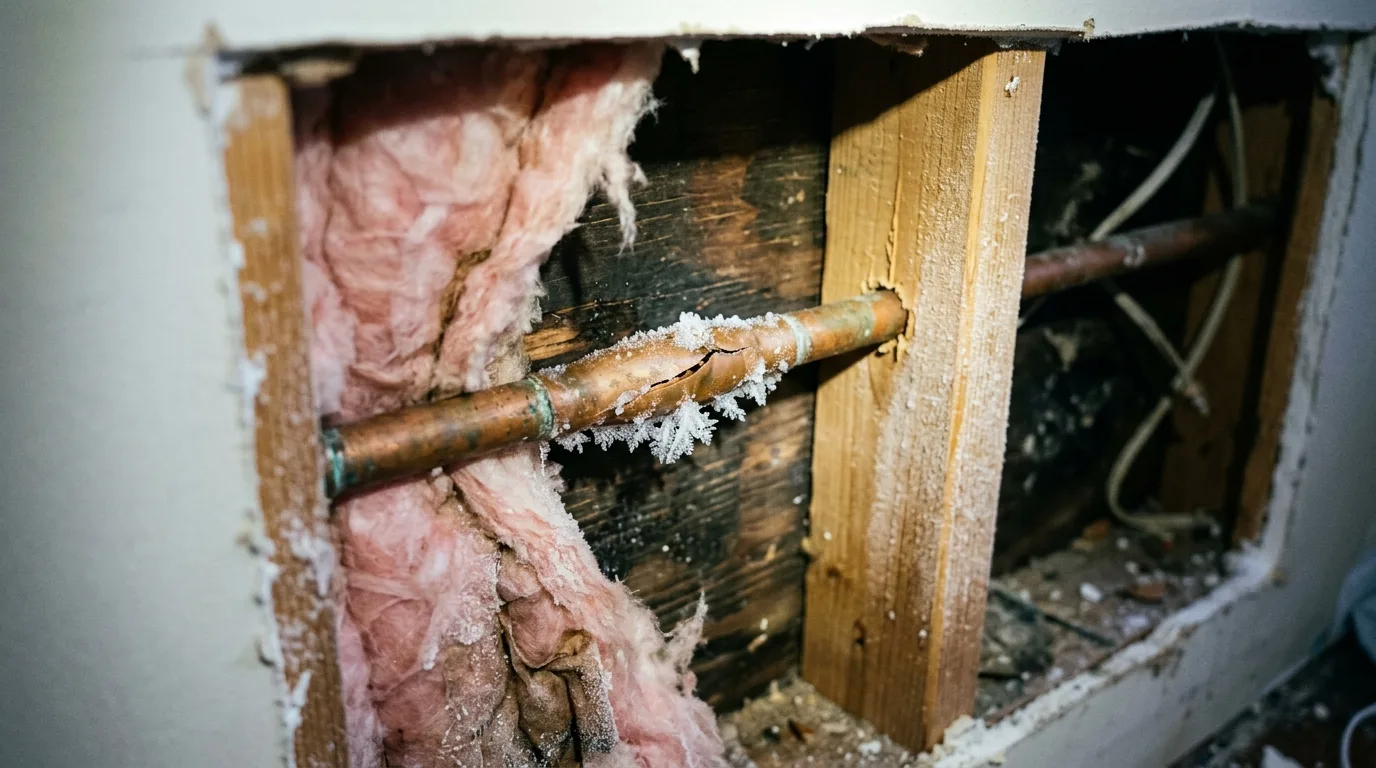
Every January, Saratoga Springs homeowners discover the hard way that a pipe frozen overnight can cause $5,000 to $70,000 in water damage by morning. In this post, we cover which pipes in Utah County homes are most vulnerable to freezing, how to protect them before temperatures drop, what to do when prevention fails, and how to handle the water damage aftermath.
Burst Pipe Emergency in Saratoga Springs? We Respond 24/7
Emergency water extraction and frozen pipe damage restoration for Utah County homeowners. Call (877) 698-1311.
Why Frozen Pipes Are Utah County’s #2 Water Damage Cause
By the time a Utah County homeowner discovers a burst pipe, the water has usually been running for hours. Pipes freeze during the night when temperatures drop and nobody is watching — they burst when they thaw in the morning as water pressure returns to a weakened pipe wall. The water damage from a burst pipe that ran overnight fills basements, soaks through floors, and saturates wall cavities in a way that’s often more extensive than flooding from outside.
Saratoga Springs averages January lows of 23°F, with the record low reaching -10°F. The city’s semi-arid cold — dry air with hard freezes — creates a different freeze pattern than wet-climate cold. Pipes in exterior walls and crawl spaces can freeze even when indoor temperatures are maintained, because the thermal bridging through inadequately insulated framing allows exterior cold to reach pipe temperatures well below 32°F. In newer Saratoga Springs construction, the build pace of the 2000s–2020s sometimes left insulation gaps around plumbing penetrations that create ongoing freeze vulnerabilities.
Types of Pipes That Freeze First in Utah County Homes
Exterior wall supply lines: Any pipe running inside an exterior wall with inadequate insulation between the pipe and the exterior sheathing is at high risk. This is most common in homes where pipe routing prioritized construction convenience over thermal protection.
Garage supply lines: Pipes serving hose bibs, utility sinks, and ice makers in garages are exposed to essentially outdoor temperatures. Detached garages and workshops are particularly vulnerable because nobody thinks to heat them overnight.
Crawl space plumbing: Homes with uninsulated or inadequately sealed crawl spaces see temperatures that closely track outside air. Any supply lines running through a ventilated crawl space without insulation wrap can freeze during a cold snap.
Attic supply lines: In homes where plumbing serves upper floors and routes through unconditioned attic space, even short exposed runs can freeze when attic temperatures drop into the teens or lower.
Hose bibs: Exterior hose bibs that are not frost-proof and have not been drained of interior water before winter are among the most commonly frozen pipes in Saratoga Springs.
Practical Steps to Prevent Frozen Pipes
-
Insulate exposed pipes before November: Pipe insulation foam is inexpensive and easy to install. Focus on crawl spaces, garages, exterior walls where pipes are accessible, and attic runs. Cover all hose bib connections.
-
Disconnect and drain exterior hose bibs: Remove garden hoses before the first hard freeze. Open the exterior hose bib to drain remaining water from the interior valve. For standard (non-frost-proof) hose bibs, shut the interior shutoff valve and open the exterior bib to drain.
-
Keep cabinet doors open during cold snaps: Kitchen and bathroom cabinets under exterior walls contain supply lines. During periods below 20°F, open cabinet doors to allow heated interior air to reach the pipes.
-
Maintain a minimum thermostat setting: Even when away from home, maintain indoor temperatures above 55°F. The cost of slightly elevated heating is trivial compared to the cost of burst pipe water damage. If traveling, ask a neighbor to check the home during extreme cold snaps.
-
Know where your main shutoff is: Every adult in the household should know how to shut off the main water supply immediately. In a burst pipe situation, getting to the shutoff within the first minute can mean the difference between a manageable event and a flooded basement.
Frozen Pipes Already Burst? Call Us Now — Utah County Wide Response
Immediate water extraction, moisture detection, and structural drying for burst pipe emergencies. (877) 698-1311.
Types of Freeze Protection Products
Standard pipe insulation foam: Foam pipe covers provide moderate protection for interior pipes in mildly cold spaces. Adequate for crawl spaces and garages during typical cold snaps.
Electrical heat tape: For pipes that are genuinely difficult to insulate adequately — runs through exterior walls, attic penetrations — thermostatically controlled electric heat tape maintains pipe temperature actively. The thermostat ensures the tape only activates when temperatures drop near freezing.
Insulation wrap with vapor barrier: For crawl space pipes, closed-cell foam pipe insulation combined with a vapor barrier over the crawl space floor reduces ambient moisture and temperature exposure simultaneously.
Automatic pipe drain valves: These mechanical valves drain a pipe section when pressure drops to zero (such as when a shutoff valve is closed). Useful for hose bib supply lines and irrigation systems.
What to Do When a Pipe Freezes
-
Do not apply open flame. A torch or lighter on a frozen pipe is a house fire waiting to happen. Use a hair dryer, heat lamp, or electric heat pad — never an open flame.
-
Apply heat starting from the faucet end. Work back from the faucet toward the frozen section, not from the frozen section toward the faucet. This allows steam to escape as the pipe thaws rather than building pressure.
-
Leave the faucet open while thawing. Flowing water helps thaw the remaining ice and confirms when the pipe is fully open.
-
Check all faucets before assuming you’re done. When one pipe freezes, adjacent pipes in the same wall cavity often freeze too. Test all fixtures on exterior walls before the next cold night.
-
If you can’t locate or access the frozen section, call a plumber. Attempting to thaw a pipe you can’t reach by guessing where to apply heat is ineffective and can cause the pipe to fail at a point you’re not monitoring.
How to Handle Burst Pipe Water Damage
If a pipe has already failed, the damage response sequence matters enormously. See our complete burst pipe emergency guide for step-by-step instructions. The key principle: turn off water at the main shutoff, document the damage with photos, and call both your insurance company and a water damage restoration professional within the first hour.
Burst pipe water damage costs in Saratoga Springs range from $5,000 to $70,000 depending on how long the pipe ran and what structural materials were affected. Water that soaks into subfloors, wall cavities, and insulation requires professional moisture detection and industrial drying equipment — this is not work that can be adequately performed with consumer-grade fans and dehumidifiers. The water damage restoration process for a burst pipe typically involves 3–5 days of drying followed by reconstruction of affected materials.
Cost Factors for Frozen Pipe Prevention and Repair
Pipe insulation materials for a typical Saratoga Springs home cost $50–$200 in materials — a fraction of the average burst pipe insurance claim. Electrical heat tape installation for a particularly vulnerable run costs $100–$400 including materials and labor. These numbers make prevention straightforward math compared to the $2,079–$2,136 average water damage restoration cost for a moderate event, or the $5,000–$70,000 range for a serious burst pipe situation.
Frequently Asked Questions
At what temperature do pipes freeze in Utah County homes?
Water freezes at 32°F, but residential pipes typically don’t freeze until the air surrounding them drops to 20°F or below — the insulating value of walls, cabinets, and building materials provides a buffer. Pipes in exposed locations (crawl spaces, garages, exterior walls without adequate insulation) can freeze faster. The commonly cited “6-hour rule” — pipes in exposed spaces can freeze in 6–8 hours at temperatures below 20°F — is a reasonable planning guideline for Utah County conditions.
Does homeowners insurance cover burst pipe water damage in Utah?
Yes — burst pipe damage is one of the most universally covered water damage events in standard homeowners policies. The burst must be sudden and accidental, not the result of neglected maintenance (such as a pipe that was known to be at risk and not addressed). Your insurer will want to know that you maintained adequate heat in the home. See our guide on insurance coverage for water damage in Utah for specifics.
How do I find a frozen pipe I can’t see?
Turn off the main water supply and check each faucet in sequence — the frozen section will be upstream of the faucet that has no water. Thermal imaging cameras can locate temperature differentials in walls that indicate frozen pipe locations. If you can’t locate the frozen section yourself, a plumber with thermal imaging equipment can find it quickly. Do not attempt to run water through a pipe when the frozen section is unknown — pressure can cause the pipe to fail at the frozen point.
Burst Pipe This Winter? We're Ready for Utah County Emergencies
Saratoga Springs Water Damage Restoration handles burst pipe extraction, drying, and full reconstruction. Call (877) 698-1311.
Related: